
Tom Green Court Records After Arrest
After an arrest in Tom Green County, the person may be booked into the Tom Green County Detention Center while the legal case moves on a separate track. The jail roster is the custody record. The court record begins when a complaint, information, indictment, docket entry, bond order, setting, plea, dismissal, or judgment is filed with the proper court. The District Attorney page explains that law-enforcement agencies present completed investigations for prosecutor screening before a complaint is filed, and that an assistant district attorney reviews evidence and probable cause.
That distinction matters. A roster charge can be amended, reduced, dismissed, refused, no-billed, or replaced by a formal filing. The court record is the source for filed charges and case status. The jail profile is still useful because it can give an SO number, booking number, arresting agency, booking date, charge text, and bond display. For custody and booking fields, use Tom Green County jail inmate records; for booking photos, use Tom Green County jail mugshots.
The county's Odyssey Public Access portal is the main public case-search route for Tom Green court records after a jail arrest.
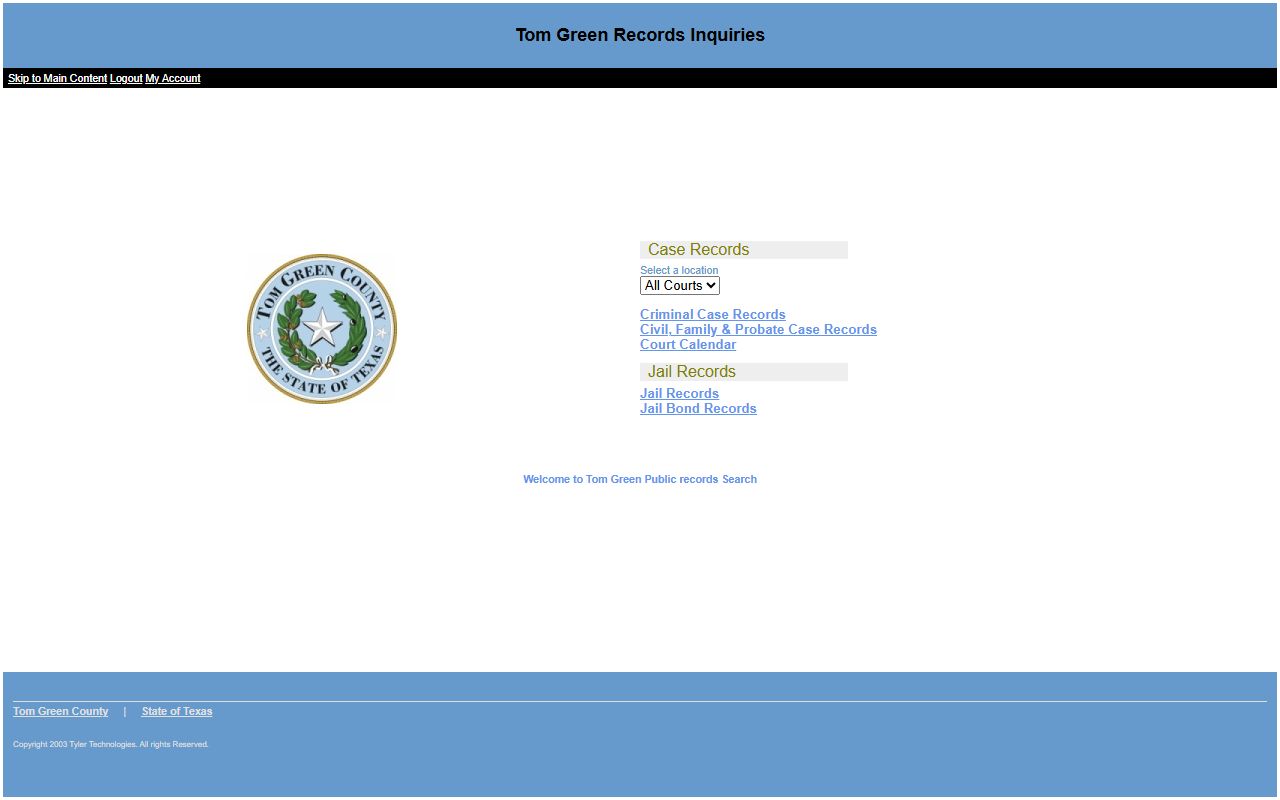
The portal is the bridge from arrest and booking facts to filed criminal case records and court calendar information.
Search Tom Green Court Records
The county homepage links users to Search Judicial Records, and the public access portal confirms categories for Criminal Case Records, Civil, Family and Probate Case Records, and Court Calendar. The research could not fetch every field because the portal caused a redirect loop during browser inspection, so the safe approach is to treat the listed fields as partial and use the clerk offices when a case cannot be found online.
- Open Tom Green Public Records Search / Odyssey Public Access and choose the criminal case path.
- Search by defendant name first if no case number is known.
- Use a case number if it came from the jail, a bond company, the clerk, a citation, or a court notice.
- Open the case record and compare the filed charge list with the arrest charge from the jail roster.
- Check docket entries and settings to see whether the charge is pending, dismissed, pled, set for hearing, or otherwise changed.
| Field Label | Type | Required | Notes |
|---|---|---|---|
| Criminal Case Records | Navigation option | No | Search category for criminal cases. |
| Civil, Family & Probate Case Records | Navigation option | No | Separate public case categories. |
| Court Calendar | Navigation option | No | Docket or calendar lookup. |
| Name / Party | Text | Unspecified | Use the defendant's name when no case number is known. |
| Case Number | Text | Unspecified | Best when a clerk, jail, bond company, or court notice has supplied the number. |
| Search / Submit | Button | n/a | Runs the portal search. |
Charges After a Tom Green Arrest
Tom Green County felony charging is shaped by prosecutor screening and grand jury review. The District Attorney page says local law-enforcement agencies submit completed investigations to the District Attorneys' Office before a complaint is filed. An assistant district attorney checks whether the facts support an offense and probable cause. If a felony case proceeds, the prosecutor sends it to a grand jury, usually within one to four weeks according to the DA page. A true bill becomes an indictment. A no-bill ends the case at that stage.
| Document | Who uses it | What it does |
|---|---|---|
| Complaint | Law enforcement or prosecutor | A sworn charging document that supports criminal process and, in the DA's description, is generally needed before an arrest warrant. |
| Information | Prosecutor | A prosecutor-filed charging instrument commonly used for misdemeanor prosecution and some non-indictment contexts. |
| Indictment | Grand jury | A felony charging instrument returned as a true bill after grand jury review. |
District courts in Tom Green County have original jurisdiction in felony criminal cases. The county lists the 51st, 119th, 340th, and 391st District Courts, plus an appointed Criminal Magistrate Judge for felony criminal matters, Felony Drug Court, and Juvenile Drug Court. Misdemeanors usually route to county courts supported by the County Clerk criminal department.
Tom Green Criminal Court Offices
Different offices hold different records. The District Clerk handles district-court records, which matter for felony cases. The County Clerk criminal department handles misdemeanor county-court records and gives a public contact route for criminal records, payments, and case questions. The District Attorney is a prosecution office, not the general custodian for all public court records, but its process page is useful for understanding what happens after a jail arrest.
County Clerk Criminal Department
124 West Beauregard
San Angelo, TX 76903
325-659-6555
criminal.records@co.tom-green.tx.us
District Clerk
112 W. Beauregard
San Angelo, TX 76903
325-659-6579
Use for felony district-court record routing.
Tom Green Charge Status Records
Charge status can change at several points after an arrest. A law-enforcement charge listed on the jail roster may not be filed by the prosecutor. A filed charge may later be amended, reduced, dismissed, refused, no-billed by the grand jury, resolved by plea, or tried. The court case record is where those changes should be checked because the jail roster is mainly a custody tool.
| Status | What it means |
|---|---|
| Pending | The case or charge remains open and has not reached final disposition. |
| Amended | The filed charge has changed from an earlier version. |
| Reduced | The prosecution or court record reflects a lower charge level or lesser offense. |
| Dismissed | The charge has been ended by court action or prosecutor request. |
| No-billed | The grand jury did not return an indictment for that felony allegation. |
| Convicted | The case ended in a guilty plea, verdict, or other conviction record. |
Bond Records After Arrest
Bond is tied to both the jail record and the court record. The DA page says defendants are taken before a judge soon after arrest. The judge tells the defendant why they were arrested, describes the complaint facts, sets bail, and advises rights. The DA page also says bail is meant to secure appearance in court and that the judge considers the seriousness of the offense, ability to raise money, and ties to the community.
| Bond or hold type | How it works locally |
|---|---|
| Cash bond | The full exact amount is paid before release; the jail page says in-person cash bonds over $5,000 must be cashier's check. |
| Surety bond | An approved bonding company posts the bond for a fee. |
| Personal bond | Texas allows personal recognizance release in some cases, but no Tom Green jail page detail was found. |
| No bond | A roster status that may reflect warrant, parole, ICE, transport, or another hold. |
| Detainer | A notice or hold from another agency that can affect release even if a local bond amount appears. |
Note: The sheriff roster warns that charges and bail amounts may change after court appearances, so bond should be confirmed with jail staff.
Warrants and Court Records
The sheriff publishes an official active warrant list, and the mobile app includes warrants and most-wanted features. A warrant can lead to a Tom Green County jail arrest, after which the roster may show warrant-related text such as a bench warrant or other hold. The DA page defines an arrest warrant as a judge-signed order authorizing a peace officer to arrest a person charged with a crime.
Bench warrants often connect back to a court case, such as a missed appearance. The jail profile may not show the warrant number or issuing court. Use the warrant list, court portal, County Clerk, District Clerk, or sheriff non-emergency line to route a warrant question. If legal advice is needed before appearing on a warrant, use counsel or the issuing court rather than relying only on a web list.
Charges vs Convictions
An arrest and charge are not the same as a conviction. A charge is an accusation or filed allegation. A conviction is a final case result based on a plea, verdict, or other qualifying judgment. Tom Green County court records after a jail arrest should be read with that difference in mind because early booking language can be far less exact than the final court outcome.
| Point | Charge | Conviction |
|---|---|---|
| Stage | Accusation after arrest or filing. | Final result after plea, verdict, or judgment. |
| Proof level | Often based on probable cause or prosecutor filing. | Requires the legal standard for conviction. |
| Where shown | Jail roster and court filings may show it. | Court disposition and sentence records show it. |
| Can change | Yes, it can be amended, reduced, dismissed, or no-billed. | Changes usually require later court action. |
Sealed and Expunged Records
Texas public access starts with the Public Information Act, but criminal records have limits. Juvenile justice information is treated separately under Family Code Chapter 58. Expunction is governed by Code of Criminal Procedure Chapter 55A and can affect qualifying arrest and court records after a dismissal or other eligible result.
| Point | Sealed | Expunged |
|---|---|---|
| Public visibility | Hidden from most public access, depending on the order. | Treated as removed or cleared under the expunction order. |
| Agency handling | Some government access may remain. | Agencies follow the court's expunction command. |
| Common trigger | Eligibility depends on Texas law and the court order. | Often tied to qualifying dismissals, acquittals, or other eligible outcomes. |
| How to verify | Check the court order or clerk. | Check the expunction order and affected agencies. |
Important: Court records after an arrest must not be used for credit, employment, housing, insurance, or other FCRA-covered screening through a non-CRA source.
Restricted Tom Green Court Records
Not every arrest-related record is public in full. Juvenile records, sealed or expunged records, medical information, some law-enforcement material, and information covered by statutory exceptions can be withheld or redacted. A court calendar or docket may show limited case information while the clerk controls the official file. A jail roster entry may also disappear after release or transfer, especially outside the 48-hour release window.
For older booking photos, booking sheets, or jail records that are no longer online, use a Texas Public Information Act request with the sheriff or county. For court-filed charges, use Odyssey and the relevant clerk. For prosecution-stage questions, victim/witness communications, or felony screening context, the District Attorney page provides process information, but it is not a substitute for the clerk's case file.